

Secure Your Profits: Global Supply Strategy for -18°C Soup Dumplings
11 Jun, 2026The traditional "front-store, back-kitchen" handmade model offers flawless quality. However, it suffers from two major, unavoidable bottlenecks: limited production capacity and high labor costs for expansion. When facing massive orders of millions of pieces and strict deadlines from global retail chains like Costco, traditional handmade production lines simply cannot keep up.
As soup dumplings evolve from street food into a high-profit frozen retail category, food manufacturers worldwide are adopting automated production lines with hourly capacities of thousands of pieces. Yet, to successfully capture the massive B2C frozen retail market, the ultimate winning factor in international trade is not just individual quick freezing (IQF) technology inside the factory—it is maintaining an uninterrupted -18°C cold chain journey from start to finish.
Global Export Costs: The Manufacture in Asia, Ship Overseas Strategy
Setting up factories overseas often comes with strict regulations, such as rigorous US FDA/USDA inspections, high labor costs, and severe labor shortages. In contrast, "centralized automated mass production in Asia combined with long-distance ocean freight" is the fastest, lowest-cost strategy for brands to test global markets.
According to calculations by major food manufacturers, a 40-foot reefer container can hold hundreds of thousands of soup dumplings. This makes the shipping cost per dumpling highly competitive. However, for this high-profit business model to work, the absolute lifeline is an "uninterrupted -18°C cold chain."
According to the latest Global Frozen Dim Sum Market Report published by Dataintelo Market Research, this globalization wave is growing rapidly:
| Year | Global Frozen Dim Sum Market Size | CAGR | Core Technology Driver |
|---|---|---|---|
| 2025 | USD 9.6 Billion | -- | IQF (Individual Quick Freezing) Technology |
| 2034 (Forecast) | USD 17.8 Billion | 7.1% | Continuous -18°C Cold Chain Supply Chain |
The "Glocalization" Strategy of Global Dim Sum Giants
When expanding into global channels, multinational food giants follow a clear logic: test the market via ocean freight first, then build local factories later.
- Chimei Food: When entering the European market (such as Poland and the UK), they initially adopted a strategy of "production at Taiwan headquarters, exported via full-course low-temperature ocean freight." Only after sales stabilized and surged in channels like Costco Europe, achieving economies of scale, did they shift to "technical cooperation and OEM" with local Polish food factories to gradually localize production lines.
- Ajinomoto (Japan): Their frozen dim sum, which holds a high market share in Europe and the US, followed the exact same path. In the early stages, products were exported via ocean freight from Asian bases (such as Japan and Thailand). Once overseas annual sales crossed the threshold, they acquired and renovated local factories in Europe and the US.
Whether in the initial shipping phase or the later OEM cooperation stage, international buyers prioritize one key factor when evaluating Asian suppliers: risk prediction and cold chain quality control capabilities "from the factory to overseas retail stores."
Four Core Defensive Lines for Cross-Border Logistics
To solve the consumer pain point of "frozen skin tearing and soup leaking during microwave or steamer reheating," food brands and international buyers must collaborate to establish the following four professional defensive lines in cross-border logistics:
1. First Line of Defense: Factory Departure and Container Loading
When products leave the freezer, staying at room temperature for over 15 minutes causes slight thawing, creating surface moisture. When refrozen, this moisture turns into large, sharp ice crystals that pierce the delicate dumpling skin and destroy the gluten network, leading to cracked skin and leaked soup during reheating.
Enterprise Standard Solution: Implement inflatable dock shelters to ensure a 100% airtight seal between the truck and the freezer exit for zero-temperature-variance transfers. Additionally, ocean reefers must be pre-cooled to -18°C to -20°C before loading. Never rely on the container's cooling unit to lower the temperature of newly loaded products.
2. Second Line of Defense: Ocean Transit
During a 2-to-4-week ocean voyage, containers face scorching sun and extreme weather, putting the internal airflow circulation to the test.
The Critical Detail: As frozen cooked dim sum, soup dumplings do not require fresh air. The ventilation valves must be completely closed throughout the voyage to prevent humid sea air from entering and causing frost. Furthermore, pallet stacking must never exceed the "red load limit line" to ensure cold air circulates evenly from the T-Bar floor up, eliminating any hot spots.
3. Third Line of Defense: Full-Course Digital Temperature Monitoring
When global retail chains receive goods at the dock, they demand scientific data, not verbal assurances.
Standard Technology: IoT real-time temperature sensors must be placed at the very back of the container—where air circulation ends—to record temperature and humidity curves 24/7. Upon arrival overseas, buyers can review reports directly via the cloud. The shipment is cleared and accepted only if the temperature never rose above -18°C, effectively preventing trade disputes.
4. Fourth Line of Defense: The Last Mile from Customs Clearance to Retail Shelves
This final leg—comprising customs clearance, inspection, trucking to temporary cold storage, and stocking open retail freezers—presents the most complex environment.
Key Indicator: Hypermarkets strictly audit the local dispatching efficiency of a supplier's 3PL (third-party logistics) partners. Strict SOPs must limit the transfer time from the refrigerated truck to the store freezer to just a few minutes, ensuring prior efforts do not go to waste.
Expert's Insight:
The globalization of soup dumplings is a high-precision battle for temperature control. An "uninterrupted cold chain supply chain" holds just as much commercial value as the automated production equipment inside the factory. Proving to global wholesale chains that you possess systematic cold chain planning and risk prediction capabilities is your strongest moat for building cross-border B2B trust and conquering the multi-billion-dollar global retail market.
Source: DATA INTELO
More food applications
More food machine introduction
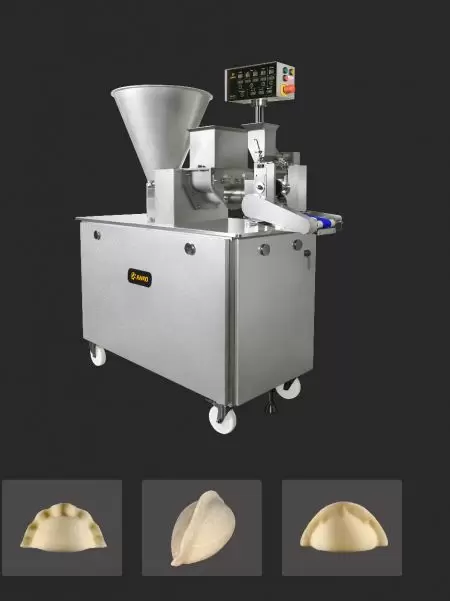
Multipurpose Filling and Forming Machine
- Tasty Appearance as handmade look
- 2,000 - 12,000 pcs/hr
- 13 - 100 g/pc